
ERP implementation, CRM integration, business intelligence, data engineering and process automation. Five doors into the same problem: the systems of record do not agree, and everyone downstream is arguing about which one is right.
Engineers across AI
Projects Delivered
Cloud-cost reduction
Client Retention
Countries Catered





Completed Projects

Enterprise data solutions are the systems that hold a company’s operational truth: ERP, CRM, warehouses, pipelines, and the reporting on top. RCV World implements, integrates,s and governs them across five services, so finance, operations and sales read the same number. Every engagement runs through one delivery model with named ownership at handover.





Cloud Migration · Kubernetes Consulting · CI/CD Pipeline Services · Site Reliability Engineering · DevSecOps
Embedded engineers via Hire DevOps Developers, Hire AWS Developers, Hire Azure Developers
AWS, Microsoft Azure, Google Cloud Platform
AWS, Azure, CNCF, Kubernetes CKA/CKAD/CKS, HashiCorp
RCV Delivery Model™ – five stages with governance foregrounded as a delivery discipline
Fixed-scope build, dedicated team, embedded engineers, or advisory
2-4 weeks
Scoped estimate before contract – start with the development cost calculator
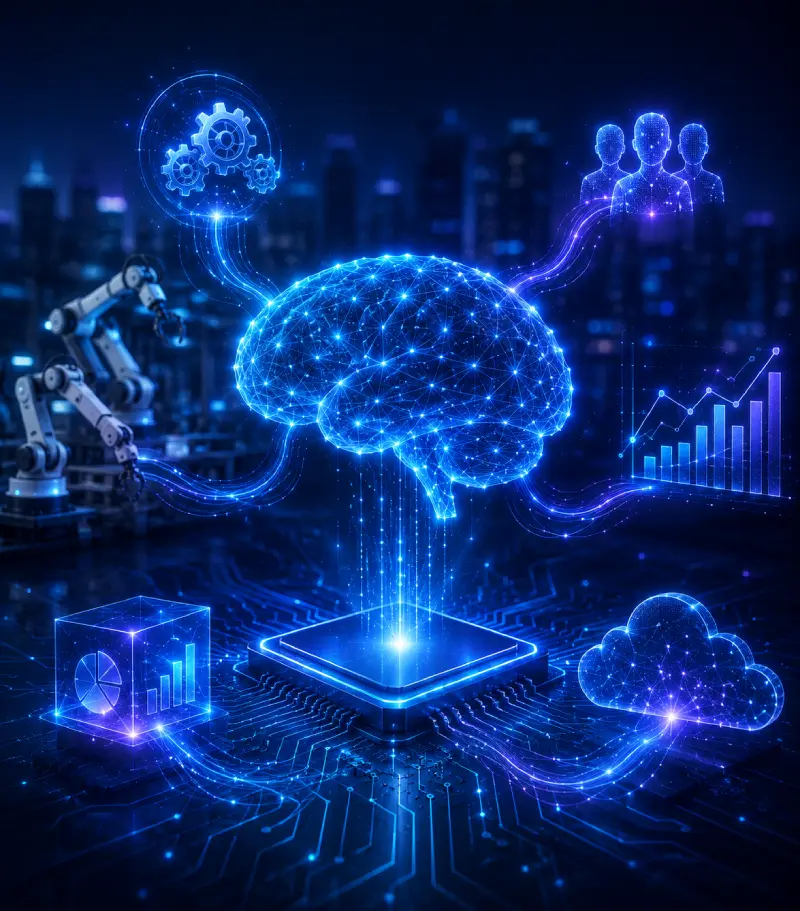
Transform your business with intelligent AI solutions that automate processes, unlock valuable insights, enhance customer experiences, and empower smarter decisions—helping you innovate faster, reduce costs, and achieve sustainable growth.
Create modern digital experiences with robust engineering, intuitive platforms, and scalable technology. We help businesses modernize systems, accelerate development, improve performance, and build digital products designed for long-term growth.
Accelerate your business with scalable cloud infrastructure and modern DevOps practices that improve agility, reliability, and delivery. From cloud migration to automation, we help teams deploy faster, reduce complexity, and operate with confidence.

Transform complex data into actionable insights with modern data platforms and enterprise solutions. We help businesses unify information, improve decision-making, streamline processes, and build a stronger foundation for intelligent growth.
Keep technology reliable, secure, and performing at its best with proactive managed services. We handle monitoring, support, optimization, and ongoing maintenance so your teams can focus on business priorities while technology keeps moving forward.
Every vendor promises a single source of truth, smarter analytics, and seamless enterprise transformation. Most projects end with another dashboard, disconnected data source, or platform nobody fully trusts. The gap isn’t more technology. It’s the engineering work between scattered systems and reliable business intelligence: modern data pipelines, governed data platforms, enterprise integrations, and systems designed to keep information accurate and accessible. That’s the work we do, as a Data & Enterprise solutions company built around connected systems, not disconnected tools.

Each service below is a separate page with its own depth. What follows is the shape of the work and the decision that sits underneath it, so you can tell which door you are standing at.
The first decision is not which ERP. It is how much of your process is genuinely differentiating and how much is just habit that a platform would standardize for free. We work on platform implementation, extension and custom ERP builds where the process really is the product. The honest position: if a configured platform covers 85 percent of your requirement, building custom to chase the last 15 percent is usually the most expensive decision available to you, and we will say so before a statement of work exists.
CRM problems are almost always integration problems wearing a CRM costume. The record exists in three systems, the reconciliation is manual, and adoption drops because the tool costs the sales team time instead of saving it. This service covers integration across CRM, ERP, billing and support platforms, plus custom CRM where the sales motion genuinely does not fit a standard object model. For Salesforce-specific build work, the deeper page is Salesforce Development under Digital Engineering.
Reporting is where the earlier failures become visible, which is why leadership usually calls about dashboards and ends up with a data-modeling engagement. This service covers semantic modeling, Power BI implementation, governance of who can publish what, and the unglamorous work of agreeing definitions before building visuals. A dashboard built on an unagreed definition is a faster way to reach the wrong number.
Pipelines, warehousing, ingestion and the tests that tell you when a pipeline is lying rather than just failing. This covers batch and streaming ingestion, warehouse and lakehouse modeling, orchestration, data-quality checks and lineage. The measure of a good pipeline is not that it ran. It is that when it did not run, the right person knew within minutes and knew what to do.
Rules-based and platform automation: approvals, reconciliation, rekeying between systems, document handling, and the workflows that quietly consume a headcount and a half. This is deliberately separate from AI Automation under AI Solutions, which covers model-driven work where the decision itself is probabilistic. If your process is deterministic and documented, automate it here and keep the model out of it. If the decision requires judgment on unstructured input, that is the other page.
| A good fit if… | Probably not a fit if… |
|---|---|
|
Your data is spread across systems and needs to become reliable and accessible
|
You only need another dashboard or reporting layer |
|
You need modern data pipelines, platforms, or enterprise integrations built around real business requirements
|
Your data sources and requirements aren’t defined yet |
|
You need engineers who can connect data, systems, governance, and business workflows |
You only need temporary analysts or extra headcount without engineering ownership |
Need experienced data and enterprise engineers without outsourcing the entire project? We place senior specialists directly within your team, aligned with your engineering leadership and priorities. From data architecture and integration to enterprise platforms and modernization, you get the expertise to move critical initiatives forward while keeping ownership in-house.
Every Cloud & DevOps services engagement runs on the RCV World Delivery Model™ – five stages with governance built in as a delivery discipline. In cloud and platform work, that governance is what keeps a migration from becoming a program that never ends.

We audit data readiness, existing infrastructure, and the specific use case before committing to an architecture – the step most AI vendors skip on the way to a demo.

Model selection, guardrail design, and team composition get signed off with your stakeholders before a line of production code is written.

Agile, product-centric delivery with the data pipelines, evaluation harness, and monitoring a production AI system needs – not just a working notebook.

Governance isn’t a status meeting – it’s executive steering, a live risk register, quality gates, and value tracking on every engagement.
Knowledge transfer, operational hypercare, and a plan for scaling the system past its first version once it’s proven in production.

Straight answers to what enterprise and fast-scaling buyers ask most.
Inside it, in most cases. Replacement is the right call when the platform genuinely cannot model your process, when the vendor has ended support, or when accumulated customizations have made upgrades untestable. Those are three specific conditions, and none of them is met by an ERP that is merely disliked. The diagnosis stage establishes which situation you are in before anyone proposes a direction, and the output is written down so the decision can be challenged. If replacement is warranted, we will say so plainly, and if it is not, we will say that too, including when a replacement program would have been the larger engagement for us.
You do, and the transition stage exists to make that real rather than contractual. Handover includes tested runbooks, named owners for each pipeline and dashboard, alerting that routes to your team rather than ours, documented definitions for every business metric, and a hypercare period where your engineers run the system while ours are still reachable. Intellectual property in code, models, pipeline definitions, and documentation is assigned to you in the master services agreement. Handover is the stage where enterprise data solutions most often fail quietly, so the practical test we apply before closing an engagement is whether your team can absorb a schema change without calling us. If they cannot, the engagement is not finished.
Both descriptions are partly right, and neither is complete. A data engineering company usually sells pipeline and warehouse build. A consultancy usually sells advice and staffs the build elsewhere. RCV World diagnoses first, then delivers with its own engineers, and stays through governance and transition. In practice, that means you get an opinion about whether the work should happen at all, which a pure build shop has little incentive to give, followed by engineers who do the work, which advisory firms typically subcontract. If what you need is genuinely only a pipeline build with the design already settled, say so, and we will scope exactly that.
Yes, and it is usually the better sequence. Two common starting points are a diagnosis engagement, which produces a written architecture and decision direction you own regardless of whether you continue with us, and a single embedded engineer through the talent bridge, which tests the working relationship at low commitment. Both are deliberately reversible. Large enterprise data solutions programs sold before a diagnosis are how organizations end up with the customization debt described earlier on this page, and we would rather earn the program on the strength of the first phase.
Start with definitions, not dashboards. When two reports disagree, the cause is rarely the visualization layer: it is that revenue, active customer, or on-time delivery mean different things in different systems, and each report is faithfully rendering its own version. The first phase is usually a short exercise agreeing definitions with the teams who own them, tracing each one back to its system of record, and identifying where the pipeline transforms them. Only then is building or rebuilding reporting worth doing. Skipping that step produces dashboards that are faster to distrust.
Diagnosis runs and produces a written direction with a cost range you can take to a budget holder. Delivery timelines vary too much by scope to quote honestly on a hub page: a CRM integration across three systems and a multi-entity ERP implementation are different orders of magnitude. What we will commit to at this stage is that the estimate arrives before the contract, that it names its own assumptions, and that scope changes are handled through change control rather than absorbed silently and surfaced as a delay. For a rough project-shaped figure, the development cost calculator is ungated.
Engineers work in your environments under accounts you issue, with least-privilege access and no standing production rights. Where possible, development and testing use masked or synthetic data rather than copies of production. Access is provisioned per engineer, never shared, and offboarding is scripted and evidenced so you can prove revocation during an audit. Data processing agreements, background checks, and vendor security reviews are completed before access is granted rather than after. For regulated clients, we expect to sit your security review in week zero, because a review discovered mid-engagement costs more than one done up front.
Enterprise Automation covers deterministic work: approvals, reconciliation, rekeying between systems, scheduled document handling, and workflows where the rules can be written down and audited. AI Automation, under AI Solutions, covers work where the decision itself is probabilistic, typically involving unstructured input such as documents, images, or free text. The distinction matters commercially as well as technically. Rules-based automation is cheaper, more predictable, and far easier to audit, so applying a modelto aa genuinely deterministic process adds cost and an explainability problem you did not previously have. If the rules can be written down, write them down.
The same engineering discipline, tuned to the regulations, integrations, and realities of your industry.
Bring the disagreement: the two reports that will not reconcile, the ERP nobody wants to upgrade, the pipeline that broke last month and took three days to notice. Enterprise data solutions start with a diagnosis, not a proposal, and the first call is with someone who has done the work.
A 30-minute call with an engineer – your platform, your workloads, your team, your constraints. No slideware.
A written diagnosis: what to migrate, what to modernize, what to hire for, what to leave in place – including the honest ‘don’t build this’ calls.
A scoped estimate with a staged plan, so the first release ships a measurable, defensible outcome before you commit to the rest.
RCV World helps businesses turn technology into measurable growth. We deliver AI, digital engineering, cloud, data, enterprise, managed, and talent solutions built around your goals. Our teams combine technical expertise, strategic thinking, and execution to create secure, scalable, and future-ready solutions for businesses across industries.
