
The Smartest Way to Manage and Scale Your EV Charging Network
Whom Does It Cater To
Charging Point Operators (CPO’s)
Site Host & Investors
Utility Teams
Is Your Charging Network Working Against You?
- Unplanned Downtime: Charger failures are not detected when not monitored in real-time, which impacts revenue and operator trust.
- Fragmented Operations: There are siloed dashboards and manual ticketing, leaving gaps in multi-site charging networks.
- Proprietary Systems: The problem is that these different charger brands are incompatible with each other, which means that operators will be locked in with the proprietary system.
- ROI Visibility Lack: CPOs lack data intelligence and do not have the data to make infrastructure decisions on ROI.
- Manual Fault Management: Where automation is not available, each fault needs manual attention, wasting time, money, and uptime.
Key Features
AI-Powered Engine
Heuristic algorithms and machine learning models work together in balancing load, failure prediction, and dynamic change of the charging times according to the grid conditions, use patterns, and demand trends.
Agentic AI Ticketing
CPOLIX automatically detects failures, creates structured tickets, assigns priority levels, and starts remote resolution workflows without manual intervention. When self-healing isn’t enough, tickets
Live Data Platform
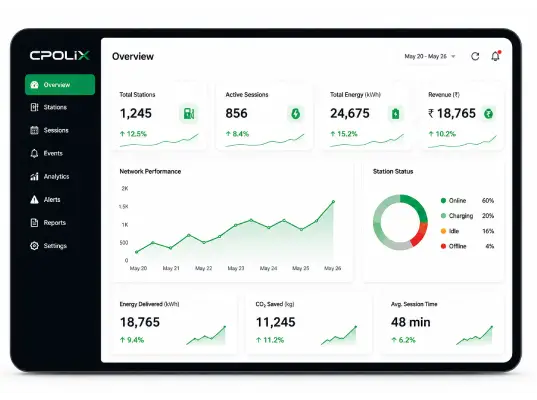
A high-performance data ingestion layer collects live data from every OCPP-enabled charger, connected vehicle, and integrated system that feeds a unified analytics layer that powers dashboards, reports, and predictive models continuously.
Remote Healing
Event-triggered APIs use remote troubleshooting techniques such as reset, push configuration, and redistribute load to fix faults. Reducing manual maintenance visits, thereby saving uptime and reducing the operational costs across the network.
Data to Intelligence: Process Flow
Step 01: Connect
- All charging stations with OCPP support are compliant with the CPOLIX platform and are added to the real-time monitoring and management layer of the network, irrespective of hardware brand or manufacturer.
Step 02: Monitor
- The platform is always pulling live data from all plugged-in charging stations, monitoring session performance, energy usage, connectivity status, and any hardware health issues 24 hours a day, seven days a week.
Step 03: Analyze
- The machine learning models analyze incoming data and compare it with the historical data. It is later processed to find trends and anomalies, and to create predictive models for future demand, fault risk, and revenue performance throughout the network.
Step 04: Act
- Agentic AI acts on performing tasks. Proactive management of energy grid balancing, remote healing, and even deployment of configurations.
Step 05: Reporting
- All reporting is done in real time and reported through the dashboard. Includes revenue reporting, session analysis, CO2 reductions, network status, and maintenance scheduling.
Step 06: Optimize
- The AI model is fed data from every session, event, and resolution. Improving the accuracy of forecasts and decision-making, and the overall efficiency, profitability, and reliability of the model over time.